Cruiser frame, flat streets, one gear. Which motor position actually makes sense?
Covers pedal-assist bicycles built for flat, short-distance riding, and what owning one near salt water involves
Bottom bracket shell width
Cruiser frames often use wider or curved bottom bracket areas that mid-drive motors were not designed to clamp onto. Measuring the shell before shopping saves a wasted conversation with a shop.
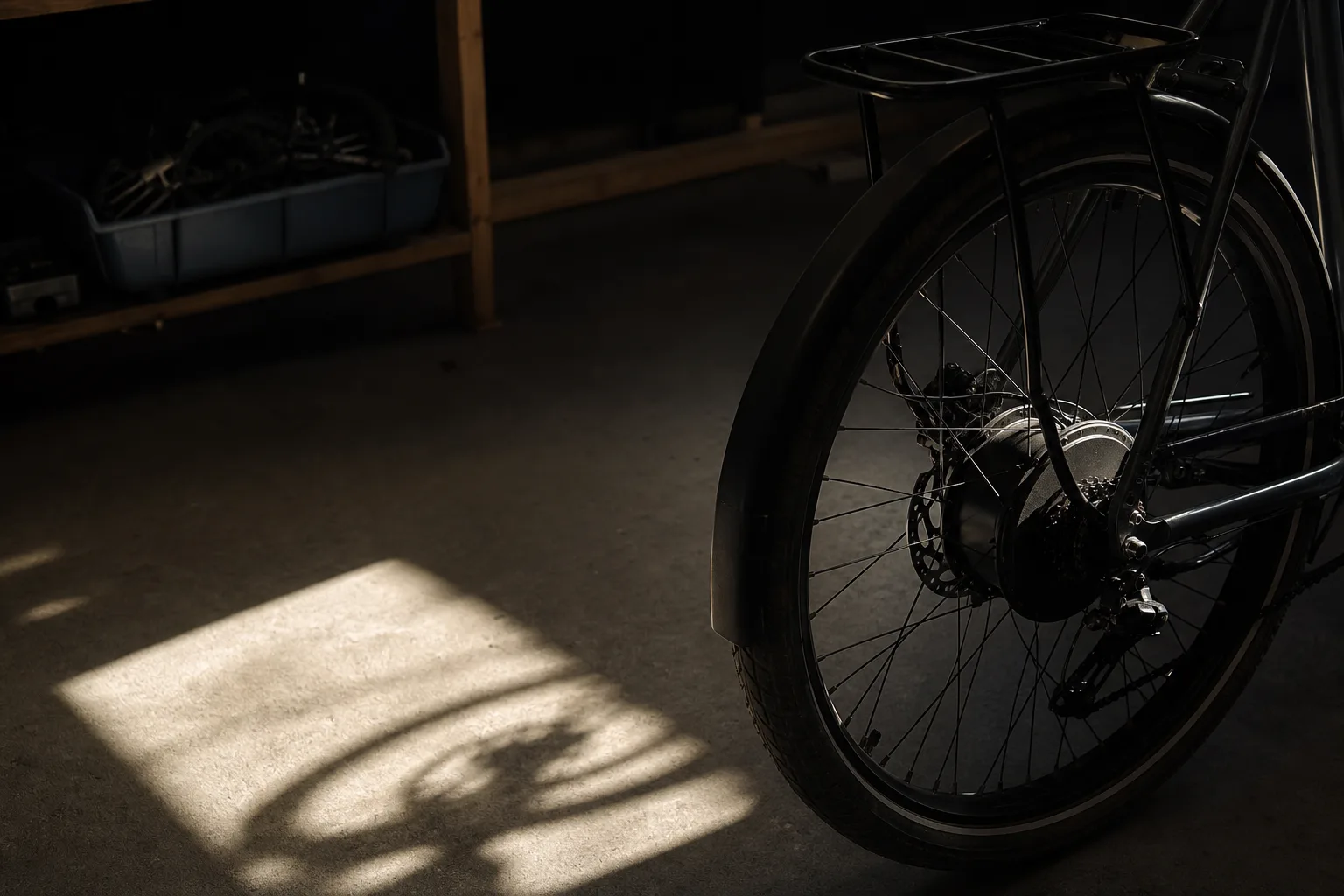
Walk down a boardwalk rack and count the motors. On the swept-back, step-through, balloon-tire bikes that dominate flat coastal towns, the motor is almost always a fat gray cylinder laced into the rear wheel, and that is not a coincidence or a cost-cutting accident. The frame decides it. A cruiser built around a single-speed drivetrain, a wide bottom bracket, and a chainline that sits well outboard leaves a mid-drive very little to work with, and the parts that would make a mid-drive worthwhile are the same parts a cruiser deliberately does without.
What the frame has already decided
A mid-drive puts its torque through the chain, which means it needs gears to be worth paying for, and it needs a bottom bracket shell it can actually clamp into. Cruiser frames tend toward wide shells, curved seat tubes, and chainstays shaped for tire clearance rather than motor clearance, so a mid-drive either does not fit or fits with spacers and a compromised chainline. Add a single-speed rear end, often with a coaster brake, and the mid-drive is reduced to a very expensive way to push one gear ratio. The rear hub asks nothing of the drivetrain and cares nothing about your cadence.
That independence is the practical argument. A hub motor keeps turning when the chain is dry, when the freewheel is dragging, and when you are coasting into a headwind with your feet still. On a bike used for a two-mile grocery run, that resilience matters more than efficiency curves. It also means the drivetrain wears at roughly the rate a non-assisted cruiser's would, which is slow, since nothing is multiplying motor torque through a half-inch chain.
What you give up when the road tilts
Hub motors make their power at road speed, so they fade exactly where you want them most: a steep, slow grade taken at walking pace. A mid-drive downshifts with you and keeps its motor spinning in an efficient range, which is why it climbs better and why it dominates on mountain bikes and cargo bikes carrying two kids. On flat ground the difference is nearly invisible. On a bridge ramp or a single block of real hill, a geared rear hub with decent torque will still get you up, more slowly and warmer, while a direct-drive hub will bog and heat if you crawl.
So the honest test is your actual route, not the spec sheet. Ride the errand you will do most often, note the steepest sustained section, and time how long you would be in it at maybe six miles per hour. If that stretch is under a minute or two, a hub motor's heat and low-speed weakness never gets a chance to become a problem. If your neighborhood delivers repeated climbs, or you carry sixty pounds of cargo, the calculus changes and a geared frame with a mid-drive starts to justify its price.
What a careful reader checks before paying
Start with the number that actually predicts hill behavior, which is rated torque in newton-meters, not the watt figure printed on the box. Then look at whether the hub is geared or direct-drive, because a geared hub freewheels and climbs better while a direct-drive is quieter and offers regenerative braking you will rarely use on flat ground. Check the dropouts: a hub motor needs a proper torque arm, and an aluminum dropout without one is a known failure point. Confirm the rear wheel's spoke gauge and whether a replacement wheel is available separately from the motor.
Then check the sensor. A cadence sensor turns the motor on when the cranks move, which feels like a switch, while a torque sensor scales assist to how hard you push and is what most people mean when they say a bike feels natural. On a cruiser with one gear, a torque sensor does more for ride quality than any amount of extra wattage. Ask what the controller and display are, whether the connectors are a common standard, and whether a local shop will service the system. The Consumer Product Safety Commission oversees safety requirements for bicycles and their electrical systems sold in the United States, and a manufacturer that answers those questions clearly usually answers the others clearly too.
When the extra money is real
A mid-drive earns its premium on a bike with a proper cassette, hydraulic disc brakes, and a frame designed around the motor rather than adapted to it. That is a different bicycle from a swept-back cruiser, and buying one means accepting a more forward riding position and more drivetrain maintenance in exchange for climbing you may never need. If you want the upright posture, the wide saddle, and the step-through frame, a well-specified geared rear hub with a torque sensor is not the compromise version. It is the correct answer to the question the frame already asked.
Sort the choice by route first, sensor second, and serviceability third, and the motor position tends to fall out of those three answers without much agonizing. The bikes that disappoint people are usually the ones where a strong motor was bolted to a drivetrain and dropout set that were never meant to carry it.
| Geared versus direct-drive hubs | A geared hub uses internal reduction, freewheels when you coast, and climbs better at low speed. A direct-drive hub is quieter and nearly maintenance-free but bogs down and heats up on slow grades. |
| Torque arms are not optional | Hub motors twist against the dropout under load, and aluminum dropouts can spread or fail without a torque arm. Check that at least one is fitted, and that its bolt is tight during routine service. |
| Cadence versus torque sensing | A cadence sensor switches assist on when the cranks turn, which feels abrupt at low speeds. A torque sensor scales power to your effort and is the single biggest contributor to a natural ride feel. |